

Freeze Sensors Compared: 9 Sensors by Connectivity, Hub Requirement and Power
A freeze sensor exists to warn you before a pipe bursts, not after. It watches ambient or surface temperature and sends an alert once a reading drops below a set threshold, giving a homeowner, property manager, or neighbor a window to intervene — raising the heat, opening a cabinet door, or activating heat tape — while the pipe is still intact. That is a different job from a standard leak sensor, which only confirms that water has already reached the floor. Research-based comparison — we have not physically tested these products. Our analysis uses manufacturer specifications, manuals, warranty/support policies, safety certifications, independent test data where available, and current marketplace availability. One honest note before the table: very few products on Amazon are marketed narrowly as “pipe freeze sensors.” Most of what functions as a freeze sensor in practice is a general-purpose smart temperature-and-humidity sensor placed near exposed plumbing, and that is exactly what fills this comparison.
Comparison Table
Products are grouped by price tier, from lowest to highest. “Key Details” pulls the single most distinguishing fact from each manufacturer’s own listing — read the notes section below the table for the full context on each one.
| Product | Brand | Price Tier | Connectivity | Power Source | Key Details |
|---|---|---|---|---|---|
 Ambient Weather F007TP 8-Channel Wireless Thermometer Ambient Weather F007TP 8-Channel Wireless Thermometer |
Ambient Weather | <$30 | Not stated | Not stated | Waterproof probe measures direct-contact temperature (water, soil, refrigerator); an accessory sensor for WS-07/08/09 weather stations |
 Aqara Zigbee Temperature and Humidity Sensor Aqara Zigbee Temperature and Humidity Sensor |
Aqara | <$30 | Zigbee (Aqara Hub required; the hub itself uses WiFi) | Battery Powered | 3-in-1 temperature, humidity, and pressure monitoring; rated accuracy of ±0.3°C, range up to 50°C (122°F) |
 Inkbird IBS-TH2 Wireless Thermometer Inkbird IBS-TH2 Wireless Thermometer |
Inkbird | <$30 | Bluetooth | Battery Powered | No hub or WiFi required; stores up to 30,000 data points on-device; rated range -40°F to 140°F |
 SimpliSafe Temperature Sensor SimpliSafe Temperature Sensor |
SimpliSafe | <$30 | SimpliSafe proprietary wireless (add-on to a SimpliSafe system) | Battery Powered | Only works as an accessory to a SimpliSafe security system; manufacturer bullets explicitly mention frozen-pipe protection; customizable 0°F–127°F threshold |
 YoLink Smart Temperature Humidity Sensor YoLink Smart Temperature Humidity Sensor |
YoLink | <$30 | LoRa (YoLink Hub required; the hub itself uses WiFi) | Battery Powered | Uses LoRa instead of home WiFi for roughly a 1/4-mile range from the hub; rated range up to 122°F |
 Govee Smart Thermometer Hygrometer Govee Smart Thermometer Hygrometer |
Govee | $30-75 | Bluetooth, WiFi | Battery Powered | 2.4GHz WiFi only; two years of free data export; app alert function is Bluetooth-only per the manufacturer listing |
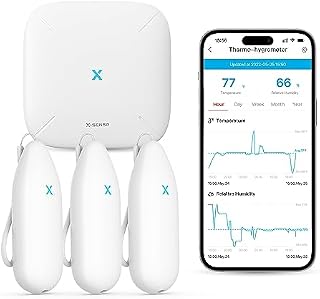 X-Sense Indoor Wi-Fi Thermometer Hygrometer X-Sense Indoor Wi-Fi Thermometer Hygrometer |
X-Sense | $30-75 | WiFi 2.4GHz via included base station | Not stated | Base station supports up to 10 sensors for multi-zone monitoring; rated range -4°F to 140°F; tabletop mounting |
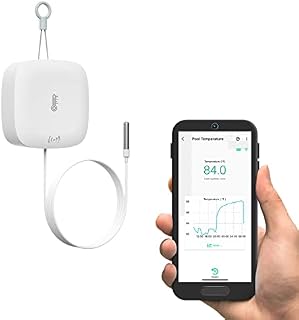 YoLink Weatherproof Fluid/Air/Surface Temperature Sensor YoLink Weatherproof Fluid/Air/Surface Temperature Sensor |
YoLink | $30-75 | LoRa (YoLink Hub required; the hub itself uses WiFi) | Battery Powered | Includes a probe rated to 221°F; manufacturer bullets explicitly list “pipe temperature monitoring” as a use case |
 Temp Stick Remote WiFi Temperature & Humidity Sensor Temp Stick Remote WiFi Temperature & Humidity Sensor |
Ideal Sciences | $75-200 | WiFi (2.4GHz) | Battery Powered (2 × AA) | No subscription of any kind; unlimited text-message alerts; rated 1–2 year battery life on 2 AA batteries; stores up to a month of readings while offline and uploads on reconnect |
Why “Freeze Sensor” Often Means a Smart Temperature Sensor
Search Amazon for “pipe freeze sensor” and the actual catalog of purpose-built, plumbing-only products is thin. Of the nine products in the table above, only two — the SimpliSafe Temperature Sensor and the YoLink Weatherproof Fluid/Air/Surface Sensor — explicitly reference frozen pipes or pipe temperature monitoring in the manufacturer’s own bullet points. The rest are general-purpose WiFi, Bluetooth, or Zigbee temperature-and-humidity sensors built for wine cellars, greenhouses, incubators, refrigerators, and reptile tanks that happen to use the exact same underlying mechanism a dedicated freeze sensor relies on: a temperature probe, a low-threshold alert, and a notification sent to your phone.
That is not a downside once you understand it. A Govee Smart Thermometer Hygrometer or an Aqara Zigbee Temperature and Humidity Sensor mounted in a crawlspace and set to alert below 40°F does the same job as a product labeled “freeze sensor,” because the alert logic is identical — cross a threshold, send a push notification. What matters for this category is not the product name on the listing but three underlying specs: the temperature range the unit is rated to measure accurately, whether it needs a hub or a subscription to deliver alerts, and how far its wireless connection reaches from an unheated space back to your router or hub. Shop those specs directly rather than searching for a “freeze sensor” label, and the general-purpose sensors in this table become fully legitimate candidates.
What These Specs Mean for Your Decision
Connectivity is the first fork in the road. Four of the nine products in this table need something beyond a phone and a WiFi network to function. The Aqara Zigbee Temperature and Humidity Sensor will not bind to Apple HomeKit or Alexa without an Aqara Hub, and the manufacturer’s own listing is explicit that third-party Zigbee hubs are not supported. Both YoLink products — the YoLink Smart Temperature Humidity Sensor and the YoLink Weatherproof Fluid/Air/Surface Temperature Sensor — require a YoLink Hub, but in exchange they trade WiFi for a LoRa radio link, which is the reason YoLink advertises roughly a quarter-mile of range between sensor and hub. That range matters specifically for this category: a detached garage or a crawlspace at the far end of a foundation can sit outside typical WiFi range but well within LoRa range.
Four of the remaining products — Ambient Weather, Inkbird, Govee and X-Sense — connect more directly, over Bluetooth, WiFi, or both, without a dedicated smart-home hub. That simplifies setup, but it introduces its own limits worth checking against your installation: the Govee listing notes its app alert function only works over Bluetooth settings, and both Govee and X-Sense state their WiFi radios support 2.4GHz networks only, not 5GHz. If your router broadcasts both bands under one name, that distinction can quietly break a connection during setup. The X-Sense sensors also report through an included base station rather than joining WiFi individually, so the base is the unit that needs network coverage. The SimpliSafe Temperature Sensor belongs in the hub-dependent group rather than this one: it uses SimpliSafe’s own wireless protocol and is not a standalone product at all, but an accessory that requires an existing SimpliSafe security system to function.
Power source is straightforward across this table: every product with a power source stated runs on batteries, which is typical for sensors installed in unheated, hard-to-wire locations like crawlspaces and garages. Two listings — Ambient Weather and X-Sense — do not state a power source at all, so confirm battery type and expected runtime directly with the seller before mounting one somewhere inconvenient to reach. The Temp Stick is a middle case worth knowing about: it carries no labeled power-source field either, but its battery description and its own bullets both specify two AA cells and a 1–2 year life, which is why this table states it rather than leaving it blank.
One thing no product in this table offers is a cellular connection. That matters for the exact scenario this category exists to cover — a winter storm that takes down power and internet together — because every option here ultimately depends on either your home WiFi or a hub that has internet. The closest partial answer is the Temp Stick, which keeps logging readings while offline and uploads up to a month of stored data once the connection returns; you lose the real-time alert during the outage but not the record of what happened. If a genuinely network-independent alert is your requirement, that is a different purchase than anything in this comparison — see our no-WiFi and long-range monitors comparison, which documents what the market does and does not currently offer.
Notes on Each Product
Ambient Weather F007TP 8-Channel Wireless Thermometer — This is a remote sensor probe designed as an add-on for Ambient Weather’s WS-07, WS-08, and WS-09 weather stations, and it ships included with the WS-09. Its waterproof probe is built to measure direct-contact temperature in mediums like water, soil, refrigerators, or freezers, which makes it usable near a pipe even though the listing does not market it as a plumbing product. Connectivity and power source are not stated on the manufacturer listing, so confirm compatibility with your existing weather station display before buying.
Aqara Zigbee Temperature and Humidity Sensor — A 3-in-1 sensor tracking temperature, humidity, and atmospheric pressure through the Aqara app, with a stated accuracy of ±0.3°C and a measurement range extending to 50°C (122°F). The listing is explicit that an Aqara Hub is required and that third-party Zigbee hubs are not supported, which is the key constraint to weigh against an existing smart-home setup.
Inkbird IBS-TH2 Wireless Thermometer — A Bluetooth-only sensor with no hub or WiFi dependency, which keeps setup simple at the cost of Bluetooth’s shorter range compared to the LoRa or WiFi options in this table. The manufacturer states a temperature range of -40°F to 140°F and on-device storage of up to 30,000 data points, along with app-based graphing and high/low alarm notifications.
SimpliSafe Temperature Sensor — One of only two products in this comparison whose manufacturer bullets specifically call out frozen-pipe protection. It functions only as an accessory within a SimpliSafe home security system, communicating on SimpliSafe’s own wireless protocol rather than WiFi or Bluetooth, and offers a customizable alert threshold across a 0°F to 127°F range, with a stated wireless range of 1,000 feet.
YoLink Smart Temperature Humidity Sensor — Uses YoLink’s LoRa-based wireless protocol rather than home WiFi, which the manufacturer markets as extending roughly a quarter mile from the required YoLink Hub. The rated range tops out at 122°F, and the listing frames it as suitable for placement well beyond normal WiFi range, including outbuildings and detached structures.
Govee Smart Thermometer Hygrometer — A Bluetooth-and-WiFi sensor using a Swiss-made temperature component rated to ±0.54°F (±0.3°C) accuracy, with two years of free data export through the Govee Home app. WiFi support is limited to 2.4GHz networks, and per the manufacturer listing the threshold-based alert function itself is only supported over Bluetooth settings, not WiFi.
X-Sense Indoor Wi-Fi Thermometer Hygrometer — Ships with a base station supporting up to 10 sensors, making it the option in this table best suited to monitoring several zones — a crawlspace, a garage, and a basement, for instance — from one hub. Manufacturer-rated accuracy is ±0.36°F across a -4°F to 140°F range, and the listed mounting style is tabletop rather than wall- or ceiling-mounted.
YoLink Weatherproof Fluid/Air/Surface Temperature Sensor — The second product in this table whose manufacturer bullets directly reference pipe temperature monitoring as an intended use case, alongside pool water, wood boilers, and livestock troughs. It includes a probe rated up to 221°F, connects through the same LoRa-based YoLink Hub system as the other YoLink product here, and its weatherproof rating separates it from the mostly indoor-oriented sensors elsewhere in this comparison.
Temp Stick Remote WiFi Temperature & Humidity Sensor — A WiFi-only sensor whose selling point is the absence of a subscription: the manufacturer’s own bullets frame it as avoiding the recurring cellular-service costs that competing remote sensors carry, and it supports unlimited text alerts rather than restricting texts to a paid tier. It is stated as made in the USA, runs 1–2 years on two AA batteries, and keeps recording while offline, uploading up to a month of stored readings once it reconnects. WiFi support is limited to 2.4GHz networks.
Where to Place a Freeze Sensor
Placement matters more than any individual spec on this page. A sensor sitting in a heated living room will rarely register anything useful, because the value of this whole category is concentrated at the coldest, least-monitored points in a home’s plumbing — an unheated crawlspace, an attached or detached garage, a three-season cabin, or a basement corner far from a furnace. Within those spaces, position matters too: cold air infiltrates fastest near a rim joist, an exterior wall, or a garage door header, so a sensor mounted close to one of those points will typically read the true worst-case temperature sooner than one mounted at the center of a room. For the full discussion of placement strategy, alert-threshold selection, and how a freeze sensor complements a standard leak sensor, see our Freeze Sensors & Cold-Weather Protection category guide.
FAQ
Do any of these sensors work without a smart-home hub?
Five of the nine do: the Ambient Weather F007TP, Inkbird IBS-TH2, Govee Smart Thermometer Hygrometer, X-Sense Indoor Wi-Fi Thermometer and Temp Stick connect over Bluetooth, WiFi, or both without a separate smart-home hub — though the X-Sense reports through an included base station. Four need something else: the Aqara sensor requires an Aqara Hub (third-party Zigbee hubs are explicitly not supported), both YoLink sensors require a YoLink Hub, and the SimpliSafe sensor requires an existing SimpliSafe security system.
Which of these products are actually marketed for frozen pipes?
Only two, based on the manufacturers’ own listing text: the SimpliSafe Temperature Sensor explicitly mentions protecting against frozen pipes, and the YoLink Weatherproof Fluid/Air/Surface Temperature Sensor lists pipe temperature monitoring among its stated use cases. The other seven products are general-purpose temperature-and-humidity sensors that can serve the same function using the same threshold-alert mechanism.
Can I use one of these sensors somewhere with no WiFi, like a detached garage?
The two YoLink products are built for exactly that scenario — their LoRa radio connects to a YoLink Hub rather than to WiFi directly, with a manufacturer-stated range of roughly a quarter mile. The hub itself still needs an internet connection, so this solves distance rather than the absence of a network. No product in this table has a cellular radio.
What temperature range should I check before buying?
Stated ranges vary across this table, from the Inkbird’s -40°F to 140°F down to the Aqara sensor’s rated range up to 50°C (122°F). Since a freeze sensor’s entire job is registering cold, low-end range and how far below freezing the unit remains accurate both matter more here than the upper bound of the range.