

No-WiFi and Long-Range Water Monitors Compared: 9 Options for an Unoccupied Property
Monitoring a property you are not living in is a different problem from monitoring the house you sleep in. A leak in an occupied home gets caught by a person; a leak in a cabin, a rental, or a seasonal second home runs unattended until someone visits. That changes what you need from a sensor — not just detection, but a path for the alert to reach you across a property with patchy WiFi, or no WiFi at all. Research-based comparison — we have not physically tested these products. Our analysis uses manufacturer specifications, manuals, warranty/support policies, safety certifications, independent test data where available, and current marketplace availability. One finding shapes this entire page, and we state it before the table rather than after: none of the products available in this category carry a cellular radio. The section below the table explains what we found instead, and which of the three genuine approaches fits which property.
Why There Are No Cellular Monitors in This Comparison
This category exists because a cellular water monitor — a sensor with its own LTE radio and SIM, reporting over a carrier network instead of the property’s internet — is the theoretically ideal answer for an unoccupied building. It keeps working when the router loses power, when the ISP account lapses, or when the property never had broadband in the first place.
We checked the current marketplace catalog for this category against that definition, looking for any mention of LTE, a SIM card, or a cellular network in the manufacturer’s own listing text. We found none. Every product marketed into the “no WiFi water sensor” and “vacation home water monitor” searches falls into one of three other groups, and several listings that appear cellular at a glance are describing a 2.4GHz WiFi band rather than a 4G connection.
That is worth knowing before you shop, because it means the honest question is not “which cellular monitor should I buy” but “which of these three compromises matches my property”:
- Long-range radio to a hub — the sensor uses LoRa or a sub-GHz proprietary link to reach a hub that may sit hundreds of feet away, and the hub carries the internet connection. This solves distance, not the absence of a network.
- Local alarm only — a self-contained siren with no radio at all. It needs nothing and never fails to connect, but it only alerts someone within earshot.
- Conventional WiFi — including whole-home flow monitors with automatic shutoff, which need a working router and internet at the property.
There is one thread worth pulling, and it changes where you should look rather than what you should buy here. YoLink’s listings state that its hub range includes a Cellular Hub alongside the standard Hub and SpeakerHub. That does not make any sensor in this table cellular — the sensors still speak LoRa to whatever hub is present — but it means the cellular link, where it exists at all in this ecosystem, lives in the hub rather than in the sensor. If a carrier-network alert path is your requirement, price the hub, not the sensors, and confirm the current subscription terms with the manufacturer before committing: none of the sensor listings here disclose what a cellular hub costs to run.
Otherwise, a genuinely network-independent alert is a purchase to make outside this catalog, most likely from a monitoring service that supplies its own hardware rather than from a retail sensor listing.
Comparison Table
Products are grouped by price tier, from lowest to highest. The Connectivity column states what the alert path actually is — this is the column that matters most for an unoccupied property, and where the marketing language is loosest.
| Product | Brand | Price Tier | Connectivity | Power Source | Key Details |
|---|---|---|---|---|---|
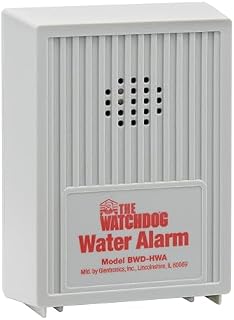 Basement Watchdog 110 dB Water Alarm (BWD-HWA) Basement Watchdog 110 dB Water Alarm (BWD-HWA) |
Basement Watchdog | <$30 | None — local alarm only | Battery Powered (alkaline) | Detects as little as 1/32 in. of water; 6 ft. sensor wire that accepts more than 100 ft. of additional wire; 5-year warranty |
 Zircon Leak Alert Water Leak Detector, 2-Pack Zircon Leak Alert Water Leak Detector, 2-Pack |
Zircon | <$30 | None — local alarm only | Battery Powered (9V, not included) | Designed to float during a flood and keep signaling for up to 72 hours; 90 dB alarm; limited lifetime warranty |
 YoLink Water Leak Sensor 2 YoLink Water Leak Sensor 2 |
YoLink | <$30 | LoRa (YoLink Hub required, sold separately) | Battery Powered | Rated 1/4-mile open-air range; 105 dB built-in siren; 4.2 ft rope-style sensing cable; device-to-device pairing keeps sensor-to-device actions running if internet or AC power drops |
 GoveeLife Smart Water Leak Detector 1s GoveeLife Smart Water Leak Detector 1s |
GoveeLife | <$30 | Sub-1GHz to included gateway; gateway needs 2.4GHz WiFi | Battery Powered | Manufacturer-stated 1804 ft range through up to five dense walls; SMS, email and app alerts; 4.92 ft sensor cable; rated 5-year battery; IP67 |
 Flood Buzz Small Water Leak Detectors, 6-Pack Flood Buzz Small Water Leak Detectors, 6-Pack |
Flood Buzz | $30-75 | None — local alarm only | Factory-sealed battery, not user-replaceable | No setup, no app, no battery installation; up to 95 dB at the leak; replace-by date stamped on the housing; 1.75 × 1.5 × 1.5 in. |
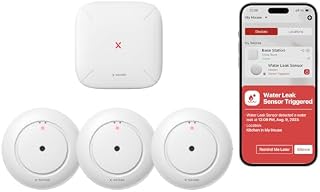 X-Sense Wi-Fi Water Leak Detector SWS54 (3 + base station) X-Sense Wi-Fi Water Leak Detector SWS54 (3 + base station) |
X-Sense | $30-75 | Proprietary RF to base station; base station needs 2.4GHz WiFi | Battery Powered (alkaline) | Manufacturer-stated 1700 ft transmission range; sensor and base sound together at up to 110 dB; detects from 0.015 in. (0.4 mm); IP66; 5-year warranty |
 YoLink Water Leak Starter Kit: Hub + 4 Leak Sensor 1 YoLink Water Leak Starter Kit: Hub + 4 Leak Sensor 1 |
YoLink | $30-75 | LoRa (hub included) | Battery Powered (2 × AAA, up to 5-year life) | The hub is in the box, so nothing else is needed to start; rated 1/4-mile open-air range (listed maximum 1320 ft); app, email and SMS alerts; sensors are silent by design — no built-in siren; one hub supports 300+ devices |
 YoLink FlowSmart NSF Certified Water Meter & Auto Shutoff YoLink FlowSmart NSF Certified Water Meter & Auto Shutoff |
YoLink | $200-500 | LoRa (YoLink Hub included); hub takes Ethernet or 2.4GHz WiFi | Battery Powered (lithium, 10+ year design) | NSF certified; ultrasonic meter plus motorized shutoff valve for 3/4″ pipe; closes the valve automatically on abnormal use; offline device-to-device rules keep shutoff working without internet |
 Moen Flo 3/4-inch Smart Water Shutoff Moen Flo 3/4-inch Smart Water Shutoff |
Moen | $500+ | WiFi | AC mains (CR123A lithium backup) | Learns the property’s usage pattern and shuts water off on an abnormality; app, phone-call and email alerts; fits 3/4″ to 1-1/4″ pipe; professional installation recommended |
What These Specs Mean for Your Decision
The first question is not range or price but who is going to receive the alert. Three of the nine products here — the Basement Watchdog alarm, the Zircon Leak Alert, and the Flood Buzz 6-pack — have no radio of any kind. For a house with people in it, that is a perfectly good design: a 90-110 dB siren in a laundry room does its job. For an unoccupied cabin, it does nothing unless a caretaker or neighbour happens to be within earshot. Buy these for an unoccupied property only if someone checks the building regularly, or as a cheap secondary layer alongside a connected system.
If the alert has to travel, the useful distinction is between products that solve distance and products that solve connection. The YoLink Water Leak Sensor 2 and the YoLink Starter Kit both use LoRa, an industrial low-power radio that the manufacturer rates at a quarter mile in open air, and their listings are explicit that the sensors do not join your WiFi network at all — they talk to the YoLink Hub, and the hub carries the internet connection. The GoveeLife 1s (1804 ft claimed) and the X-Sense SWS54 (1700 ft claimed) do the same thing with proprietary sub-GHz radios and their own gateway or base station. All four let you put a sensor in a detached garage, a well house, or a crawlspace at the far end of a foundation. None of them removes the need for internet at the hub.
Two products go further in a way worth understanding precisely. YoLink’s device-to-device pairing — described on both the Leak Sensor 2 and the FlowSmart listings — lets a sensor trigger another YoLink device directly, so a leak can still close a valve or sound a siren when the internet is down or AC power has failed. That is a genuine resilience feature, and it is the closest thing in this comparison to network independence. It is not the same as reaching your phone: the local action continues, the remote notification does not.
Power source splits the same way. Every sensor here runs on batteries, with claimed lives ranging from the Flood Buzz’s sealed non-replaceable cell to the GoveeLife’s rated five years and the FlowSmart’s ten-year design. For a property visited twice a year, battery life is not a convenience spec — it is the difference between a device that is still working next season and one that died quietly in February. The only mains-powered product in the table is the Moen Flo, which carries a CR123A lithium backup and, being a main-line valve, is also the one product here whose installation typically involves a plumber.
Detection Only, or Detection Plus Shutoff?
For an unoccupied property this is the decision that carries the most money on both sides. A sensor tells you a leak has started; someone still has to get to the building and turn the water off. If the property is four hours away, an alert on its own may not prevent much damage.
Two products in this table close the water themselves. The FlowSmart pairs an ultrasonic meter with a motorized shutoff valve for 3/4″ pipe, holds an NSF certification for potable-water use, and — through the offline device-to-device rules — is designed to keep performing the shutoff even when the internet is unavailable. The Moen Flo takes a different approach: it learns the building’s normal usage pattern and acts on deviations from it, which is well suited to a property with a predictable, near-zero baseline, and it alerts by phone call as well as app and email. Both are main-line installations, both sit in the top two price tiers here, and both are covered in more depth on our Detector + Shutoff Combo Systems hub and its comparison table.
Notes on Each Product
Basement Watchdog 110 dB Water Alarm (BWD-HWA) — A self-contained alarm built around a detachable sensor on a 6-foot lead, which the manufacturer states can be extended with more than 100 feet of additional 24-gauge wire. That makes it unusually flexible for reaching into a sump pit or along a foundation wall from a mounted position. Detection is rated down to 1/32 inch of water, the alarm is 110 dB, and it carries a 5-year warranty. There is no radio and no app.
Zircon Leak Alert Water Leak Detector, 2-Pack — The distinguishing feature is behavior during an actual flood rather than a drip: the unit is designed to float on rising water and keep signaling for up to 72 hours, where a floor-mounted alarm may be submerged and silenced. It runs on a 9V alkaline battery that is not included, sounds at 90 dB, and is backed by a limited lifetime warranty. Note that the manufacturer’s listing is internally inconsistent about the pack count, describing three units in the bullet text of a product titled as a 2-pack — confirm the quantity with the seller before ordering.
YoLink Water Leak Sensor 2 — The least expensive genuinely long-range option here. It uses LoRa rather than WiFi, rated to a quarter mile in open air, and adds a 105 dB siren on the sensor itself so it doubles as a local alarm. The 4.2-foot rope-style cable can encircle a water heater or run under a dishwasher, and additional cables can be added. A YoLink Hub is required and is not included — budget for it, because the sensor does nothing on its own.
GoveeLife Smart Water Leak Detector 1s — Uses a sub-1GHz radio to an included gateway, with a manufacturer-stated 1804 ft range through as many as five dense walls, and offers the widest alert menu in this table: SMS, email and app push, plus a 105 dB local alarm. The listing states unlimited free SMS. Two constraints to note: the gateway supports 2.4GHz WiFi only, and it pairs only with GoveeLife’s own H5059/H5830 sensors, so expansion is locked to that line.
Flood Buzz Small Water Leak Detectors, 6-Pack — The simplest product here by design. The battery is sealed at the factory and cannot be replaced, which the manufacturer frames as a deliberate choice — no battery compartment means no installation error — with a replace-by date stamped on each housing and a stated active life of up to three years. At 1.75 × 1.5 × 1.5 inches it fits behind a toilet base or under a dishwasher kick plate where larger alarms will not. Up to 95 dB, no app, no setup.
X-Sense Wi-Fi Water Leak Detector SWS54 — Ships as three detectors plus a base station, with a manufacturer-stated 1700 ft transmission range between sensor and base. When triggered, sensor and base sound together at up to 110 dB, so an alert is audible at the base location as well as the leak. Detection is rated from 0.015 in. (0.4 mm) across six probes, the housing is IP66, and it carries a 5-year warranty with a 60-day money-back guarantee. The base station requires 2.4GHz WiFi and is not compatible with 5GHz networks.
YoLink Water Leak Starter Kit: Hub + 4 Leak Sensor 1 — The same LoRa architecture as the Leak Sensor 2, but with the hub in the box, which removes the hidden cost that applies to every other YoLink product in this table. Maximum range is listed at 1320 ft, batteries are rated up to five years, and it supports app, email and SMS alerts with sensors nameable by location. Two things to know: the Leak Sensor 1 units are silent by design with no built-in siren, so an audible alert needs a SpeakerHub or a YoLink siren added; and the platform scales to 300+ devices on one hub, which is the argument for starting here if the property will grow more sensors later. Alexa, IFTTT and Home Assistant compatible.
YoLink FlowSmart NSF Certified Water Meter & Auto Shutoff — The most capable product in this comparison and the only one carrying a third-party certification: NSF, for potable-water use. It combines an ultrasonic flow meter with a motorized shutoff valve, detects abnormal usage as well as leaks, and closes the valve on its own. The hub is included, and the offline device-to-device rules are designed to keep the shutoff functioning without internet. Battery design is rated beyond ten years, and the listing notes that the ultrasonic measuring tube is intentionally narrower than the nominal pipe size to meet accuracy standards — worth checking against your flow requirements.
Moen Flo 3/4-inch Smart Water Shutoff — A main-line monitor and shutoff that builds a picture of the property’s normal water use and acts on departures from it, which suits a building with a near-zero baseline between visits. Alerts come by app, email and phone call, and it integrates with Alarm.com, Ring, Google Assistant and NICE. It fits 3/4″ to 1-1/4″ pipe, runs on mains power with a CR123A backup cell, and the manufacturer recommends professional installation. It is WiFi-only, so it depends on the property having working broadband.
FAQ
Which of these actually work with no WiFi at the property?
None of them deliver a remote alert with no network at all. The three local alarms — Basement Watchdog, Zircon and Flood Buzz — work with no network but only sound where they sit. The LoRa and long-range RF products (both YoLink sensors, GoveeLife, X-Sense, FlowSmart) let the sensor be far from the hub, but the hub still needs an internet connection. If you need an alert to leave a building with no broadband, this catalog does not currently offer it.
Do any of these have a cellular connection or SIM card?
No sensor in this comparison does. We checked every product in this category against the manufacturers’ own listing text for LTE, SIM or cellular-network references and found none. Several listings mention “2.4G”, which refers to the 2.4GHz WiFi band, not a 4G cellular connection — an easy misread when shopping. The one cellular reference in the category belongs to a hub rather than a sensor: YoLink lists a Cellular Hub among its hub options, sold separately from every kit in this table.
What happens if the power goes out while I’m away?
Every sensor here is battery powered, so the sensors themselves keep running; the failure point is the hub, gateway or base station, which needs mains power. YoLink’s device-to-device pairing is the one feature in this table designed for that case: it lets a sensor trigger another YoLink device directly, so a local siren or valve shutoff still happens with the internet or AC down, even though the notification to your phone will not go out. The Moen Flo has a CR123A backup battery.
Is a shutoff valve worth it for a seasonal property?
It depends mainly on how quickly someone can reach the building. An alert with no one nearby to act on it still leaves water running. The FlowSmart and the Moen Flo both close the supply themselves, which is the argument for the higher price tiers when the property is distant or empty for months. Our Leak Detector vs. Automatic Shutoff Valve guide works through that trade-off in full.
How long will the batteries last between visits?
Claimed lives vary widely: the GoveeLife 1s is rated at five years, the YoLink Starter Kit’s AAAs up to five, the FlowSmart is designed for ten-plus, and the Flood Buzz carries a sealed cell rated up to three years with a replace-by date printed on the housing. For a property you visit rarely, treat this as a primary spec rather than a detail, and see our battery life and replacement guide.