

Standalone Water Leak Detectors
Standalone water leak detectors are alarm-only sensors: they sense moisture and sound a local alarm, send a phone notification, or both — but they do not shut off water on their own. That makes them the entry point into leak protection, the category most homeowners buy first, and the category to understand before deciding whether you also need an automatic shutoff valve or a fully integrated detector + shutoff combo system. Research-based comparison — we have not physically tested these products. Our analysis uses manufacturer specifications, manuals, warranty/support policies, safety certifications, independent test data where available, and current marketplace availability.
How Standalone Leak Detectors Work
Nearly every device in this category uses one of two sensing methods. Point sensors sit on the floor or are mounted low on a wall and detect water only when it physically touches two exposed metal contacts or a conductive probe. Rope or cable sensors extend that same principle along a length of cable, so any point along the run — not just a single spot — can trigger an alarm. Once triggered, the sensor communicates the event one of three ways: a loud onboard siren, a push notification through WiFi and an app, or a signal to a hub over Zigbee or Z-Wave that then relays the alert to your phone.
Because these are alarm-only devices, the actual leak response is manual — you get notified, and you (or someone you designate) has to physically turn off water or address the source. That is the fundamental tradeoff versus valve-equipped systems: standalone detectors cost far less per sensor and are simpler to install, but they require someone to act on the alert in time to matter.
Key Decisions Before You Compare Models
WiFi vs. Zigbee vs. Bluetooth Sensors
WiFi sensors connect directly to your router and send alerts even if you’re away from home, but they go dark if your internet or router loses power during a storm — often exactly when leaks happen. Zigbee sensors route through a separate hub with its own battery backup in some cases, trading a bit of setup complexity for resilience. Bluetooth sensors are the simplest to set up but only alert a phone within range, making them a poor fit for anything beyond a nearby laundry room or bathroom. They are also less common than their prominence in search results suggests, and not the budget option they are often assumed to be — the least expensive products in this category are unconnected local alarms, not Bluetooth ones.
Single-Point vs. Rope/Cable Sensors
A single-point sensor is a small puck placed exactly where water would pool first — under a water heater or beside a washing machine. A rope or cable sensor extends detection along an entire run, which matters for long baseboards, the full perimeter around a water heater, or a finished basement wall where a leak could originate anywhere along its length rather than at one predictable spot.
Multi-Pack Kits for Whole-Home Coverage
Buying sensors in 3-, 6-, or 10-packs lowers the per-sensor cost substantially compared to buying single units, and it encourages the kind of comprehensive placement that makes a detection system actually useful. The tradeoff is planning: a scattered single sensor under one sink provides far less protection than the same budget spent covering every known risk point in the home.
Sensor Placement Strategy
Placement determines whether a detector catches a leak early enough to matter. High-value locations include water heaters, washing machine supply lines and drain pans, dishwashers, under every sink with supply lines, sump pump basins, and HVAC condensate pans — all common failure points that are often hidden behind cabinetry or in low-traffic areas where a slow leak can go unnoticed for weeks.
Connectivity and Reliability Tradeoffs
Connectivity is the single biggest factor separating models within this category, and it deserves more attention than sensor sensitivity or design. A WiFi-only sensor is simple to set up — no hub, no pairing sequence beyond joining your network — but it is entirely dependent on your home’s internet and power staying up. Some WiFi models include a battery backup for the sensor itself, but if the router or modem loses power, the alert still cannot leave the house.
Zigbee and Z-Wave sensors solve part of that problem by routing through a dedicated hub rather than your general-purpose WiFi network, and some ecosystem hubs include cellular or battery backup of their own. The cost is an added device in your network and, in some ecosystems, a subscription for remote monitoring. Our guide to leak detectors by hub type breaks down which smart-home ecosystems each connectivity type supports. If your home has spotty WiFi coverage or you’re setting up detection at a vacation property with unreliable internet, our cellular and no-WiFi monitor hub covers connectivity options built specifically for that scenario.
What These Sensors Do Not Do
It is worth being direct about the limits of this category. A standalone detector cannot stop water from flowing — it can only tell you that water is present. If no one is home, or the alert goes unnoticed for hours, a slow leak can still cause significant damage before anyone responds. Homeowners who travel frequently, own a second property, or want a “set it and forget it” level of protection are often better served by a system that pairs detection with automatic shutoff. See our detector vs. shutoff valve comparison for a direct look at when each approach makes sense.
Typical Price Range
Individual point sensors are the cheapest hardware on this site, concentrated in the under-$30 and $30-75 tiers, and multi-packs bring the per-sensor cost down further — which is why covering several rooms is usually a better use of a fixed budget than buying one premium sensor. Connectivity is a weaker predictor of price than you might expect: the unconnected local alarms and the connected sensors overlap heavily in the low tiers, and Bluetooth in particular is rare in this category rather than a budget option, appearing on around 5% of listings. Rope and cable sensors run higher per unit because of the added cable and sensing wire, and whole-home flow monitors — which are a different product class that happens to surface in the same searches — reach the $200-500 and $500+ tiers. Current prices and stock are on Amazon; the full comparison table shows where nine specific models fall.
Who Should Consider a Different Category
If your primary concern is a single high-risk appliance like a water heater or washing machine and you want the water physically stopped the moment a leak is detected, a standalone detector alone will not deliver that outcome — look at combo systems instead. If your goal is protecting unheated spaces like a cabin or crawlspace from frozen and burst pipes rather than detecting standing water, our freeze sensor hub covers that adjacent but distinct problem.
Common Questions
Do standalone leak detectors need a hub?
It depends on the connectivity type. WiFi and Bluetooth sensors typically work without any separate hub. Zigbee and Z-Wave sensors require a compatible hub to relay alerts to your phone, though some smart speaker and smart-home platforms include hub functionality built in.
How long do the batteries last in a leak sensor?
Most point sensors run on a coin-cell or AA battery and last 6 months to 2 years under normal conditions, according to manufacturer specifications. Battery life depends heavily on how frequently the sensor checks in with WiFi or a hub, so always confirm the manufacturer’s stated interval rather than assuming.
Can I mix single-point and rope sensors in the same home?
Yes, and it’s a common approach. Many households use point sensors at discrete appliance locations and reserve rope or cable sensors for longer runs like a finished basement perimeter or the full length of a water heater closet, as long as both sensor types share compatible connectivity or app support.
Will a leak detector alert me if I’m not home?
WiFi and hub-connected sensors generally push notifications to your phone through an app regardless of your location, provided your home’s internet connection stays up. Bluetooth-only sensors will not — they are limited to the range of a nearby paired phone, which makes them unsuitable for away-from-home alerts.
Compare them
The finder below is already scoped to this class — 361 of the 988 products in the corpus. Widen or narrow it from there, or open the full leak detection finder to search everything at once. Every result is placed against the median for its own size band, where that band holds at least eight products with a stated figure.
361 products match

Moen Flo 3/4-inch Smart Water Shut Off Valve, Smart Home Water Monitor Leak Detector, Wifi Connected, App Enabled Flow Meter and Shutoff, 900-001
Weight
1.81kg
Standalone detectors · over 1.5 kg · 12 products
Weight is -20% against the class median of 2.26.

Moray Smart WiFi Water Level Sensor Water Tank Level Monitor Water Level Transmitter , Automatic Alarm Indicator for Tuya Mobile APP Solar Gateway Smart Home Remote IP67 Waterproof (ME202RSP 5m)
Weight
1.60kg
Standalone detectors · over 1.5 kg · 12 products
Weight is -29% against the class median of 2.26.

10 Pack Water Leak Detectors for Home, 100dB Waterproof Water Sensor Alarm Leak Detector for Basements, Bathrooms, Laundries, Sinks, and Windows(Battery Included)
Weight
0.91kg
Standalone detectors · 400 g – 1.5 kg · 42 products
Weight is +12% against the class median of 0.81.

Moray Smart WiFi Water Level Sensor Ultrasonic Water Tank Level Monitor Oil Tank Gauge Sensor , Automatic Alarm Indicator for Tuya Smart Life Mobile APP Smart Home Remote IP65 Waterproof (ME201RSP)
Weight
0.80kg
Standalone detectors · 400 g – 1.5 kg · 42 products
Weight is -1% against the class median of 0.81.

WiFi Water Leak Detectors 5 Pack, 120dB Adjustable Loud Water Leak Sensor, Wireless Wi-Fi Water Leak & Drip Alarm, App Alerts, 5 Water Alarm Sensors & 1 Hub for Home Kitchen, Bathroom, Sink, Laundry
Weight
0.64kg
Standalone detectors · 400 g – 1.5 kg · 42 products
Weight is -21% against the class median of 0.81.

WiFi Water Sensors – 110dB Detector with Real-time APP Notifications | 5Pack Leak Alarm with Remote Control, 2.4G Sensors for Home
Weight
0.58kg
Standalone detectors · 400 g – 1.5 kg · 42 products
Weight is -28% against the class median of 0.81.

Nuleto WiFi Water Leak Detector 1s,Water Detectors & Alarms,Water Leak Sensor with SMS,Phone Call,APP Push,492ft for Home,Basement,Kitchen,5 Pack,2.4G WiFi Only
Weight
0.55kg
Standalone detectors · 400 g – 1.5 kg · 42 products
Weight is -32% against the class median of 0.81.

RAINPOINT Floating Remote WiFi Water Leak Detector for Home Basement 3 Pack with Hub,Wireless Siren Alarm Leakage Sensor Email & APP Push Notification Kitchen Sink,Bathroom,Laundry,Warehouse
Weight
0.53kg
Standalone detectors · 400 g – 1.5 kg · 42 products
Weight is -34% against the class median of 0.81.

5 Pack Water Leak Alarm Detector, 120dB Loud Alert Water Sensor, IP66 Waterproof, Sensitive Leak and Drip Alert, Easy Installation for Home, Basement Flood Prevention, Bathroom, Sink, Laundry
Weight
0.45kg
Standalone detectors · 400 g – 1.5 kg · 42 products
Weight is -44% against the class median of 0.81.
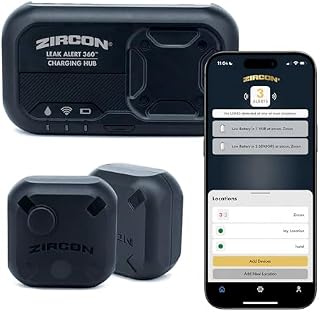
Zircon® Leak Alert 360 Smart Water Leak Detector Kit for iOS Only, WiFi Home Water Leak Detection System, Flood Sensors for Basement Kitchen Bathroom, Includes 2 Sensors and Charging Hub
Weight
0.39kg
Standalone detectors · 150-400 g · 46 products
Weight is +53% against the class median of 0.26.
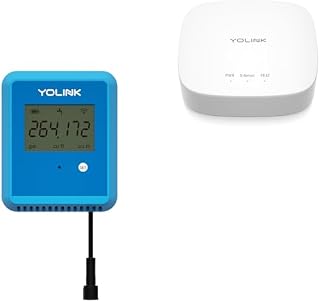
YoLink FlowSmart Smart Water Monitor and Leak Detection, Hub Included
Weight
0.36kg
Standalone detectors · 150-400 g · 46 products
Weight is +42% against the class median of 0.26.

Sump Pump Alarm with 15-Foot Float Switch | 120 dB High Water Siren | Rechargeable LiPo Battery Backup Lasts Up to 1 Week | Reliable Sump Pump Failure Detector
Weight
0.34kg
Standalone detectors · 150-400 g · 46 products
Weight is +33% against the class median of 0.26.