

Standalone Water Leak Detectors Compared: 9 Models by Connectivity and Power
Standalone water leak detectors are alarm-only devices: they sense water and sound a siren, send a phone alert, or both, but — with one exception noted below — they do not shut off the water themselves. That makes them the right fit for anyone who wants an early warning at a specific appliance or room and is confident someone will be around to respond, and the wrong fit for anyone who needs water physically stopped while they’re away. This comparison pulls together nine standalone detectors currently available on Amazon and lines up their connectivity, power source, hub requirements, and mounting style side by side. Research-based comparison — we have not physically tested these products. Our analysis uses manufacturer specifications, manuals, warranty/support policies, safety certifications, independent test data where available, and current marketplace availability.
Comparison Table
Products are grouped by price tier, from least to most expensive, then alphabetically within each tier. “Key Details” pulls out the one spec or feature that most distinguishes each model from the others in this list — read the notes section below the table for the full picture on any product.
| Product | Brand | Price Tier | Connectivity | Power Source | Key Details |
|---|---|---|---|---|---|
 Centralite by Ezlo Water Sensor Centralite by Ezlo Water Sensor |
Centralite | <$30 | Zigbee (needs a compatible hub or bridge to relay alerts) | Not stated | Contact-based sensor for placement directly on a floor or non-conductive surface; pull-tab battery activation |
 Honeywell Resideo RWD14 Water Alarm Honeywell Resideo RWD14 Water Alarm |
Honeywell | <$30 | None — local alarm only | Battery Powered | Pack of four one-time-use spot detectors with built-in, non-replaceable batteries; tabletop mount |
 SABRE Water Leakage Alarm SABRE Water Leakage Alarm |
SABRE | <$30 | None — local alarm only | Battery Powered | 110 dB alarm rated audible up to 1,500 feet; all-direction sensing with a battery test button |
 Asurity WS-1 Wet Switch Flood Detector Asurity WS-1 Wet Switch Flood Detector |
Diversitech | $30-75 | None — wired 24VAC switch; needs an alarm panel or hub | Corded Electric | 24VAC hydrophilic-pad HVAC drain-pan switch; requires a central alarm system or smart-home hub |
 Flood Buzz Small (6-Pack) Flood Buzz Small (6-Pack) |
Flood Buzz | $30-75 | None — local alarm only | Battery Powered | Six-pack with a factory-sealed, non-replaceable battery rated for up to 3 years; up to 95 dB local alarm |
 Insteon Water Leak Detector Insteon Water Leak Detector |
Insteon | $30-75 | Insteon RF (Insteon Hub required for phone alerts) | Battery Powered | Floor-placed sensor; product title states “Hub Required” — the separately sold Insteon Hub is what turns a detection into a phone alert, though the sensor can drive an Insteon Siren directly without one |
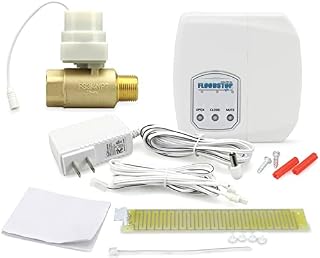 FloodStop Water Heater Leak Detector Kit FloodStop Water Heater Leak Detector Kit |
FloodStop | $75-200 | None — wired sensor and valve | AC/DC, 4 AA Optional | Sensor is paired with an automatic 3/4″ NPT shutoff valve — closes water supply on detection, not alarm-only |
 HydroCheck WaterWatcher Water Sensor Alarm HydroCheck WaterWatcher Water Sensor Alarm |
HydroCheck | $75-200 | None — wired appliance cutoff | AC | Alarms and automatically cuts power to a paired appliance, then requires a manual reset once triggered |
 Proteus AQUO WiFi Water Detector Proteus AQUO WiFi Water Detector |
PROTEUS | $75-200 | WiFi (no hub or gateway) | Corded Electric | No hub and no monthly fee; connects to home WiFi and sends email/text alerts; 5-foot detection range stated |
What These Specs Mean for Your Decision
The single biggest split in this table is between devices that only make noise locally and devices that can reach your phone — and it is a lopsided split. Five of the nine have no radio at all. The Honeywell Resideo RWD14, the SABRE Water Leakage Alarm and the Flood Buzz Small are self-contained sirens with no app, no pairing and no remote notification; the FloodStop kit and the HydroCheck WaterWatcher are wired devices that act on the equipment they are attached to rather than sending a message anywhere. SABRE leans on alarm volume instead of connectivity, rating its siren audible up to 1,500 feet, which matters if the goal is simply to be heard elsewhere in a large house rather than notified on a phone. The Honeywell and Flood Buzz units go further toward “install and forget”: both ship with a factory-sealed, non-replaceable battery, trading serviceability for zero setup.
Only two products in the list can put an alert on your phone, and they take different routes. The Insteon Water Leak Detector carries “Hub Required” in its own product title: push notifications and email alerts need the separately sold Insteon Hub. What it can do without one is link directly to an Insteon Siren for an on-site alarm — the manufacturer states that path needs no hub, app or WiFi connection. The Proteus AQUO connects straight to home WiFi with no hub or gateway and no subscription fee, sending alerts by email and text. That makes it the most self-contained option here for anyone who wants a phone alert without buying into a smart-home ecosystem.
The Centralite by Ezlo sensor is the third connected option and the one whose requirements are least explicit. It communicates over Zigbee, which means it needs a compatible hub or bridge to relay an alert anywhere — but the manufacturer listing does not name one, or state a power source. Treat the hub as a required additional purchase and confirm which controllers it pairs with before buying.
Power source is the other major tradeoff. Battery-powered units (Honeywell, SABRE, Flood Buzz, Insteon) install anywhere without an outlet nearby, which matters for under-sink cabinets or basement floors far from a plug. Corded and AC-powered units (Diversitech’s Asurity WS-1, HydroCheck’s WaterWatcher, and Proteus AQUO) trade that placement flexibility for not needing battery swaps, and two of them — the Diversitech switch and the HydroCheck WaterWatcher — go a step further by actively cutting power to the monitored equipment when triggered, rather than only sounding an alarm. The FloodStop kit is the outlier on power, too: it runs on AC/DC with 4 AA batteries as an optional backup, reflecting its role as an active shutoff device rather than a passive sensor.
Hub requirements follow the same line. Three products need something else to be useful: the Diversitech Asurity WS-1 states outright that it requires a central alarm system or smart-home hub, since it is a switch built to interrupt HVAC equipment rather than sound its own alarm; the Insteon detector needs the Insteon Hub for phone alerts, per its own title; and the Centralite sensor needs a Zigbee hub or bridge by virtue of the protocol, even though the listing does not name one. The remaining five — Honeywell, SABRE, Flood Buzz, HydroCheck and FloodStop — state no hub requirement, which is consistent with their design: none of them has a radio to pair with a hub in the first place.
Notes on Each Product
Centralite by Ezlo Water Sensor — Centralite, <$30
This is the only Zigbee product in the lineup. It’s designed to sit directly on a floor or other non-conductive surface such as tile, granite, or glass, with contacts on its underside that trigger on contact with water. Setup uses a “pull-to-pair” tab rather than an app pairing sequence, and the manufacturer positions it for placement near water heaters, drain pans, refrigerators, washing machines, or toilets. Manufacturer specifications do not state a power source or a specific hub requirement, though Zigbee sensors as a category typically need a compatible hub or bridge to relay alerts off the device itself.
Honeywell Resideo RWD14 Water Alarm — Honeywell, <$30
Sold as a four-pack of one-time-use spot detectors, each with a built-in, non-replaceable battery included in the box. It’s positioned by the manufacturer as an economical way to cover several locations at once — water heaters, behind washing machines or dishwashers, under sinks — rather than one comprehensive sensor for a single high-value spot. Mounting is tabletop-style rather than fixed to a wall or floor. No hub requirement is stated.
SABRE Water Leakage Alarm — SABRE, <$30
Built around a 110 dB siren that the manufacturer rates as audible up to 1,500 feet away, with high and low volume settings and a battery test button. The sensor detects water from any direction rather than requiring a specific orientation, and it’s wall mounted. This is a volume-first design: rather than reaching a phone, it’s meant to be loud enough to be heard elsewhere in the house, which the manufacturer specifically calls out for basements, utility rooms, and laundry rooms.
Asurity WS-1 Wet Switch Flood Detector — Diversitech, $30-75
A 24VAC corded switch purpose-built for HVAC secondary drain pans rather than general household leaks. It uses a hydrophilic pad paired with a stainless steel sensor array to draw in even small amounts of moisture through capillary action, and its solid-state, epoxy-sealed electronics are built to resist corrosion in a mechanical-room environment. Unlike the alarm-only products in this list, its stated function is to automatically shut off HVAC equipment when moisture is detected in the drain pan — but doing anything with that trigger beyond stopping the HVAC unit requires wiring it into a central alarm system or smart-home hub, which the manufacturer states explicitly.
Flood Buzz Small (6-Pack) — Flood Buzz, $30-75
Ships as a six-pack with a factory-installed, sealed 12V battery in each unit — no battery installation, tools, or app required, per the manufacturer. Each unit is rated for up to 95 dB right at the leak location and carries a stamped replace-by date as a built-in reminder, since the battery isn’t user-replaceable. The manufacturer notes that placing two units together, or stepping up to a higher-decibel Flood Buzz model, is the recommended approach for covering a larger area. Floor mounted, with no hub stated.
Insteon Water Leak Detector — Insteon, $30-75
A battery-powered, floor-placed sensor on Insteon’s own RF protocol rather than WiFi or Bluetooth. The product title states “Hub Required”, and the feature copy is consistent with it: phone push notifications and email alerts need the separately sold Insteon Hub. Without the hub, the sensor can be linked directly to an Insteon Siren for an on-site alarm, which the manufacturer says needs no hub, app or WiFi connection — so the fallback is audible, not remote. It also works with Insteon switches and plug-in modules to trigger lights or scenes, and an Insteon I/O Module can drive a shutoff valve. Installation is tool-free — the sensor is designed to be set under sinks, behind washing machines, or on a basement floor without wiring or drilling.
FloodStop Water Heater Leak Detector Kit — FloodStop, $75-200
This is the one product in this comparison that isn’t alarm-only. It’s a kit built around a 3/4″ NPT shutoff valve sized for a water heater supply line: when the sensor detects water, it closes the FloodStop valve and sounds an alarm, and the manufacturer states the valve stays closed until the water condition clears. It runs on AC/DC power with four AA batteries as an optional backup and mounts to the wall near the water heater. Because it pairs detection with an automatic valve rather than just an alert, it functions more like a single-appliance combo system than a pure standalone detector — worth knowing if you picked this comparison expecting alarm-only devices.
HydroCheck WaterWatcher Water Sensor Alarm — HydroCheck, $75-200
An AC-powered sensor manufactured in the USA and rated for pure water detection. Per the manufacturer, it sounds an alarm and automatically cuts power to the appliance it’s monitoring — commonly paired with a dehumidifier — and then requires a manual reset before power is restored, which the manufacturer frames as a deliberate safety step that stops the issue in its tracks until you can address it. Mounting style is not stated, and no hub requirement is listed.
Proteus AQUO WiFi Water Detector — PROTEUS, $75-200
A corded, tabletop-mounted sensor that connects directly to home or office WiFi with no hub or gateway and, per the manufacturer, no monthly charges. It sends alerts by email and text message rather than through a dedicated app, and it’s the only product in this table with a stated detection range — 5 feet — which is worth factoring into placement relative to the actual water source. It is the only genuinely WiFi-connected sensor here, and the only one that reaches a phone without an accompanying hub purchase.
Who Should Look at a Different Category Instead
Every product in this comparison except the FloodStop kit is alarm-only: it will tell you water is present, but nothing will physically stop the water unless a person acts on the alert. If your priority is protecting a property you’re not always present at — a vacation home, a rental, or a house where you travel often — an alarm you can’t respond to in time provides limited protection. In that case, look at our automatic water shutoff valves hub, which covers devices built to physically close a water line, or our leak detector + shutoff combo systems hub, which covers systems that pair detection and shutoff in one product the way the FloodStop kit above does for a single water heater. Both are better suited than a standalone alarm-only detector to a “stop the water automatically, notify me after” approach.
FAQ
Do any of these detectors require a smart-home hub?
Three of the nine do. The Diversitech Asurity WS-1 states outright that it requires a central alarm system or smart-home hub to do anything with a detected leak. The Insteon detector carries “Hub Required” in its product title — the Insteon Hub is what turns a detection into a phone alert, though the sensor can drive an Insteon Siren directly without one. The Centralite sensor runs on Zigbee, which needs a coordinating hub or bridge by design, even though the listing does not name a specific one. The other five — Honeywell, SABRE, Flood Buzz, FloodStop and HydroCheck — need no hub because they have no radio: they alarm, or act on wired equipment, at the point of detection.
How are these detectors powered?
It’s a mix. Honeywell, SABRE, Flood Buzz, and Insteon run on batteries — Honeywell and Flood Buzz both use a factory-sealed, non-replaceable battery rather than a user-swappable one. Diversitech and Proteus AQUO are corded electric. HydroCheck runs on AC power. FloodStop uses AC/DC power with 4 AA batteries as an optional backup. Centralite’s power source is not stated in the manufacturer data used for this comparison.
Which of these products actually shuts off the water, not just alarms?
Only the FloodStop Water Heater Leak Detector Kit closes a water supply line automatically — it pairs its sensor with a 3/4″ NPT shutoff valve. The HydroCheck WaterWatcher and the Diversitech Asurity WS-1 both cut power to a monitored appliance when triggered, which is a related but different action from shutting off a water line. Every other product in this comparison is alarm-only.
Which of these can actually notify me when I’m not home?
Two, and only one of them without buying more hardware. Proteus AQUO sends email and text alerts directly over home WiFi with no hub and no subscription. The Insteon detector can push phone notifications, but only once paired with the separately sold Insteon Hub. The Centralite sensor could in principle report through a Zigbee hub, though the listing does not name one. The remaining five — Honeywell, SABRE, Flood Buzz, FloodStop and HydroCheck — have no radio at all: they sound an alarm, or act on the equipment they are wired to, at the point of detection and stop there. If being notified while away from home is the priority, that split is the deciding factor, not price tier.